Today there are many who are engaged in activities surrounding Halloween. But October 31 is also the anniversary of the Reformation, led by Martin Luther. It is noteworthy that Luther’s study of the Scriptures illuminated his eyes to what was going on in the organized Church in his day and time.
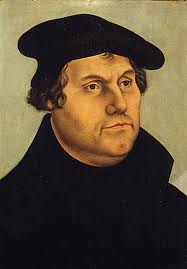 Luther did not intend to “confront the Church,” but rather, wanted to have a scholarly debate concerning a number of practices that he felt were very wrong.
In 1516–17, Johann Tetzel, a Dominican friar and papal commissioner for indulgences, was sent to Germany by the Roman Catholic Church to raise money to rebuild St Peter’s Basilica in Rome. Roman Catholic theology stated that faith alone, whether fiduciary or dogmatic, cannot justify man; and that only such faith as is active in charity and good works (fides caritate formata) can justify man. The benefits of good works could be obtained by donating money to the church.
On 31 October 1517, Martin Luther wrote to Albrecht, Archbishop of Mainz and Magdeburg, protesting the sale of indulgences. He enclosed in his letter a copy of his “Disputation of Martin Luther on the Power and Efficacy of Indulgences,” which came to be known as The 95 Theses. Hans Hillerbrand writes that Luther had no intention of confronting the church, but saw his disputation as a scholarly objection to church practices, and the tone of the writing is accordingly “searching, rather than doctrinaire.”
Hillerbrand writes that there is nevertheless an undercurrent of challenge in several of the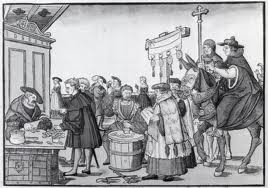 theses, particularly in Thesis 86, which asks: “Why does the pope, whose wealth today is greater than the wealth of the richest Crassus, build the basilica of St. Peter with the money of poor believers rather than with his own money?”
Luther objected to a saying attributed to Johann Tetzel that “As soon as the coin in the coffer rings, the soul from purgatory [also attested as ‘into heaven’] springs.” He insisted that, since forgiveness was God’s alone to grant, those who claimed that indulgences absolved buyers from all punishments and granted them salvation were in error. Christians, he said, must not be slacken in following Christ on account of such false assurances.
The sale of indulgences shown in A Question to a Mintmaker, woodcut by Jörg Breu the Elder of Augsburg, circa 1530.
According to Philipp Melanchthon, writing in 1546, Luther “wrote theses on indulgences and posted them on the church of All Saints on 31 October 1517”, an event now seen as sparking the Protestant Reformation. Some scholars have questioned Melanchthon’s account, since he did not move to  Wittenberg until a year later and no contemporaneous evidence exists for Luther’s posting of the theses. Others counter that such evidence is unnecessary because it was the custom at Wittenberg university to advertise a disputation by posting theses on the door of All Saints’ Church, also known as “Castle Church”.
The 95 Theses were quickly translated from Latin into German, printed, and widely copied, making the controversy one of the first in history to be aided by the printing press. Within two weeks, copies of the theses had spread throughout Germany; within two months throughout Europe.
Luther’s writings circulated widely, reaching France, England, and Italy as early as 1519. Students thronged to Wittenberg to hear Luther speak. He published a short commentary on Galatians and his Work on the Psalms. This early part of Luther’s career was one of his most creative and productive. Three of his best-known works were published in 1520: To the Christian Nobility of the German Nation, On the Babylonian Captivity of the Church, and On the Freedom of a Christian.
Michael A. Verdicchio
2010
Don’t Be Shy – Leave A Comment!
Do you have some thoughts about this? We’d love to hear what you think. Just scroll to the bottom of this post and type in your comment. (If you are receiving this post via email or RSS, just click the title above and then scroll to the bottom of the post and type in your comment.)
Share This Article!
Do you want to share this article on your website or Blog? To share on social media, like Facebook or Twitter, there are buttons below.
There’s More!
For past articles, click on the, “Posts” tab above. For past videos and podcasts, mouse over the “Posts” tab above. Look for more videos as well as more podcasts coming soon to Confidence And Joy!

 A couple of years ago at this time of year, I posted, “I Guess It’s Just Me.” I mentioned: “I don’t care for Halloween. I know, lots of people have lots of fun, but, sorry, I am not interested.”